You run things.
You keep projects moving, and Claude has become how you do it — drafting the plan, chasing the detail, turning a messy thread into a clear next step. You want to do more of that, and do it with a method rather than by feel.
Running the project. Clearing the inbox. The small tool you built one afternoon that three people now rely on. Claude has quietly become part of the job — for you and for the person two desks over. This is the course that turns that everyday habit into real craft: faster work you can stand behind, and things you build that your colleagues can actually depend on.
No card. About an hour and a half of the course, nothing held back. You will need the Claude desktop app and a paid Claude plan of your own — that is a separate subscription, not included here.
New to Claude entirely? There is a free beginners' edition — free seats for your organisation, allocated on application, subject to availability.
7
Modules, coached around real work
8.2h
In sittings of ten to fifteen minutes
2
Free modules — nothing held back
12mo
Access, from one payment
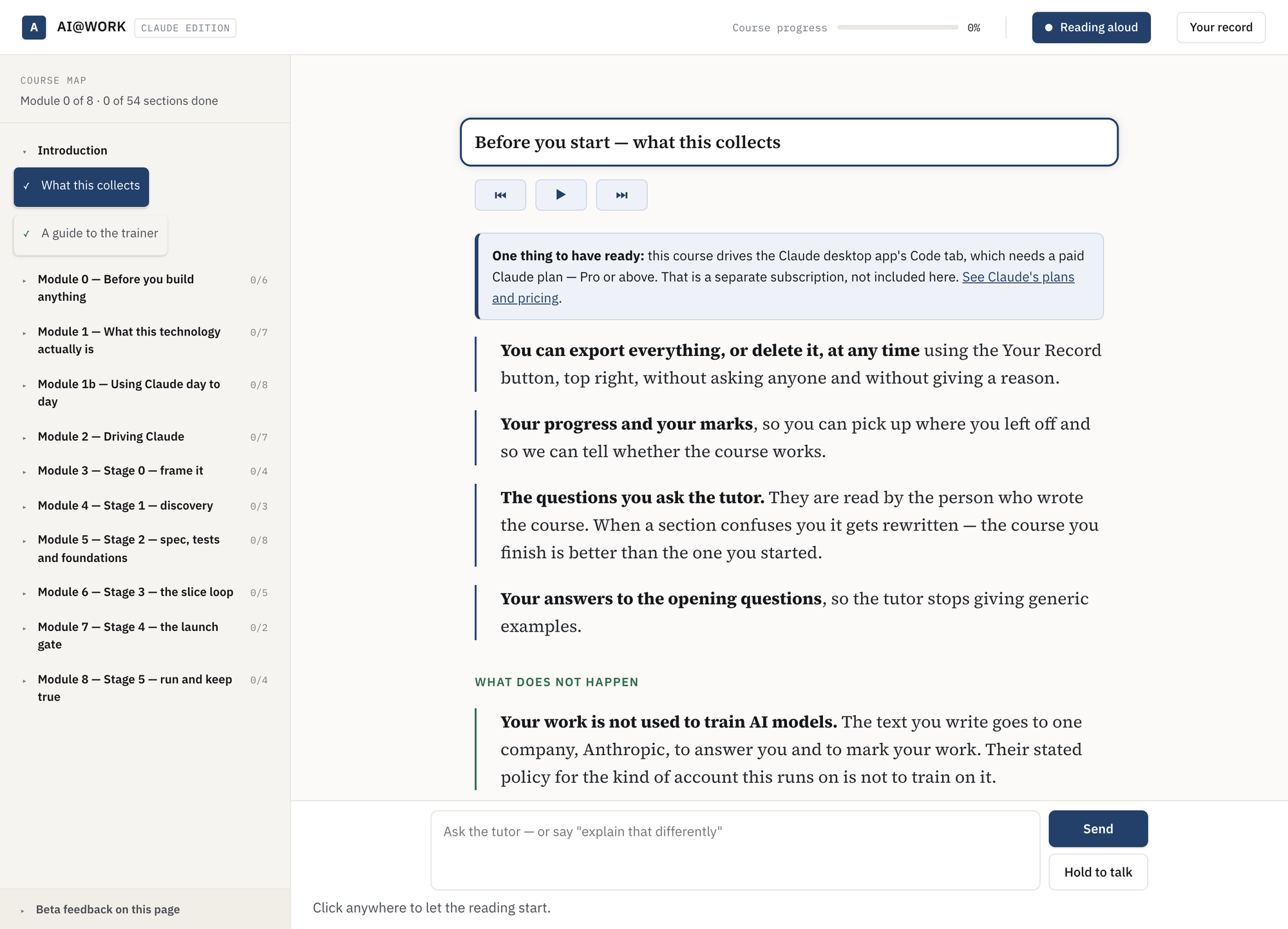
The whole course in one window: where you are on the left, the lesson in the middle, and a tutor you can ask at any point along the bottom. Read it yourself or have it read aloud. You still do the real building in your own Claude window — this is where you learn how, keep your place, and get your work marked.
This has happened three times before. Spreadsheets. Departmental databases and macros. Low-code. Each one let people build things without waiting for IT, and each one was genuinely good for the organisations that embraced it.
Here is the part worth noticing: in every wave, the people who learned to do it well — cleanly, so others could pick it up — became the ones everyone relied on. They did not just build faster. They built things that lasted, and got the credit when they did.
AI is the fourth wave, and it is the fastest, because you no longer have to learn the tool’s language at all. Which means the advantage is no longer knowing the tool. It is knowing how to build something good with it. That is a skill, it is learnable, and almost nobody has been taught it yet.
You keep projects moving, and Claude has become how you do it — drafting the plan, chasing the detail, turning a messy thread into a clear next step. You want to do more of that, and do it with a method rather than by feel.
Every so often you build something small — a tracker, a form, a script that saves the team an hour a week. It works. You would like the next one to be something you could hand to a colleague without a wince, and know it will still be standing in a year.
Everyone in your office is fumbling toward the same thing at once. You would rather be the person who clearly knows what they are doing — the one others ask. This is the shortest honest route there.
Not vague confidence — specific, checkable skills. By the end you will be able to:
Decide what is worth building before you spend an afternoon on it, and kill the ones that are not in ten minutes.
Turn a vague idea into a clear specification — the thing that makes the difference between a tool that works and a tool nobody can change later.
Read what the AI writes and judge it — accept it, question it, or send it back. A different skill from writing code, and the one that is about to matter most.
Build in thin, checked slices so you always know what works, instead of a big pile you hope is fine.
Hand it over. Leave behind something a colleague can pick up and run — which is what turns a clever afternoon into something the business actually owns.
Done well, the things you build stop being risks and start being assets — yours, and the company’s. That is the whole point.
Seven modules, about eight hours, in sittings of ten to fifteen minutes. It sits in a window beside your own Claude window while you do real work — you are not watching lectures, you are building something and being coached through it.
The tool in front of you, your project folder connected, and the shape of a good ask.
What it actually is, what it can be trusted with, what you must never put in, and how much rope to give it.
Name the project, write the charter, ask whether it should exist at all — then be interrogated about your own work, and write down what your system must never do.
The load-bearing stage: the spec, the tests written before the code, version control and house rules from scratch, and the mockup gate.
One thin slice at a time — built, machine-verified, human-reviewed, and committed or reverted rather than patched.
Going live changes the blast radius, so it gets its own gate: the pre-flight, the incident card, migration day rehearsed.
Five minutes a week, the anomaly sweep, and the handover pack that means it survives you.
You do the work in your own tools, on your own systems. The course reads what you produce and marks it against explicit criteria you can see beforehand. There are eight pieces of work, and they are about something you actually build — not exercises.
There are plenty of AI courses, and most are recorded lectures with a quiz at the end — fine for knowing about the subject, not much use for being trusted with it. This course is built differently, and every difference below is one you can check for yourself in the free modules.
The usual course
AI@Work
Watch videos, then answer a quiz.
You build a real system of your own. Eight pieces of work, submitted and marked against criteria you can read before you start.
Prompt tricks for whichever tool is current — stale in six months.
A method that does not date. Specification before code, tests before trust, a written list of things your system must never do, and a gate before anything goes live.
A certificate of attendance.
Evidence. A dated record of the work you submitted and had marked, with a reference anyone can verify — downloadable as a PDF, and yours outright even after access ends.
Questions go to a forum, or to nobody.
A tutor on every page. It answers about your actual work — it can read the files you are building — not about some average learner's.
Written by software people, for software people.
Written for people without an engineering team. No code-writing required — you learn to direct the work and judge the result, which is the skill that is about to matter most.
One more difference you can test: the figures on this page — modules, hours, pieces of work — are generated from the course itself and re-checked before every release. If the course changes and this page does not, the release fails.
A record of what you actually did — the modules, the eight pieces of work you submitted and had marked, the dates — that anyone can verify.
It lists the work and the dates, and carries a reference anyone can check — facts, rather than an opinion about you. Download it as a PDF and it is yours outright, independent of us. Which is exactly the argument the course makes about everything else you build.
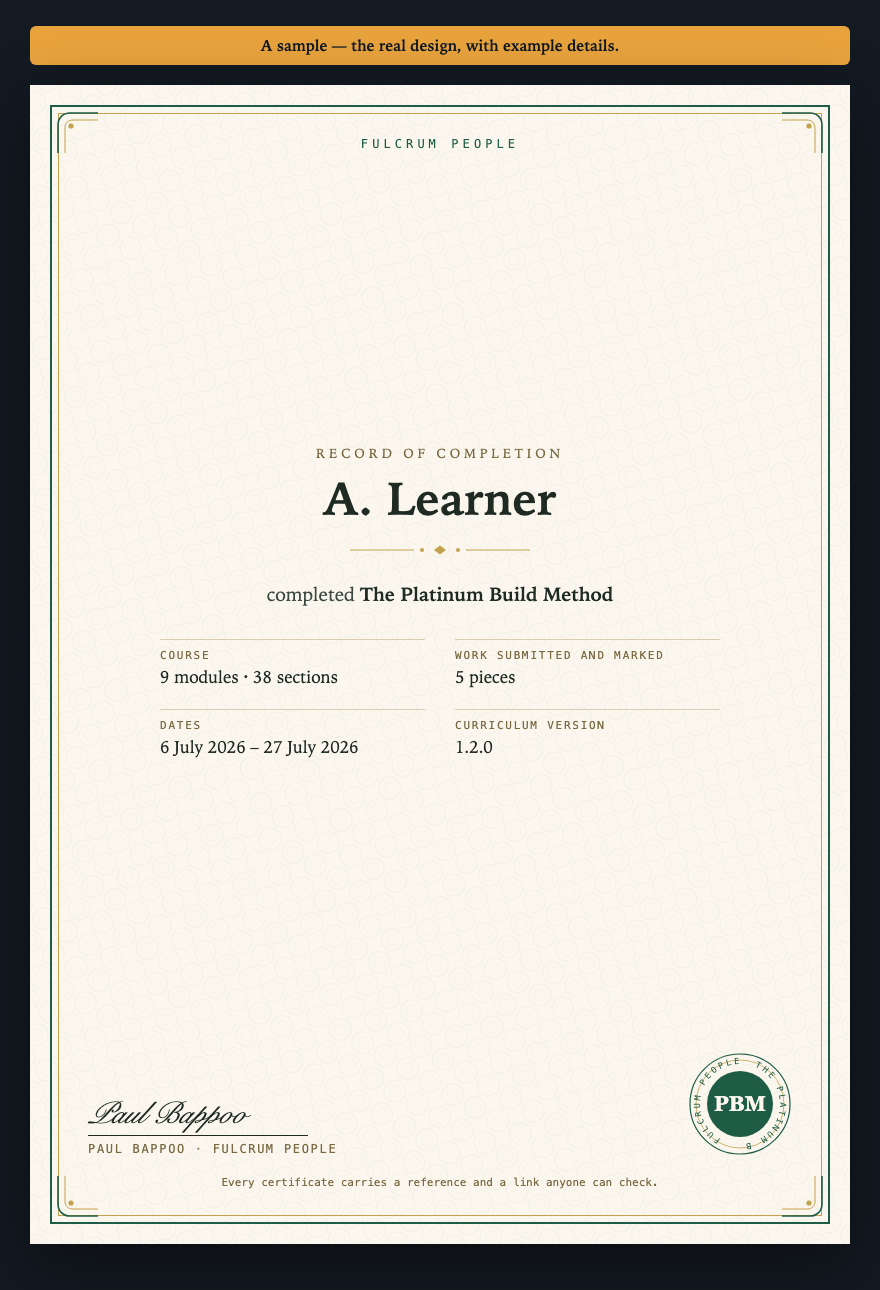
Most professional bodies let members decide which learning is relevant to their role, record it, and keep evidence of it. Completing this course produces exactly the evidence those schemes ask for:
Bodies including RICS and ICAEW accept learning that has not been separately accredited, provided it is relevant to your role and you retain evidence of completion. Members decide relevance and record it under their own scheme's rules — we would encourage you to check yours.
For managers: each seat produces its own verifiable record, so a completed cohort can be evidenced person by person rather than by an attendance list.
The Claude desktop app on a Mac or Windows machine, with a paid Claude plan — the free tier will not open the part of it this course uses. You also need Chrome or Edge for this panel, because it reads and writes files in a folder you choose and the other browsers cannot do that. A phone is read-and-review only; you cannot build a system on a phone, and we are not going to pretend otherwise.
You may not be able to install the app, and this course genuinely needs it. What to ask your IT team for: the Claude desktop application with a Pro or Team plan, for building internal tools. The first two modules are free and stay open while you wait for an answer.
Professional software engineers — you already have the disciplines this teaches, and you would be bored. This is for people who build things at work without an engineering team around them.
Paul Bappoo. Thirty years building systems inside other people’s organisations — SunSystems and Maximo implementations, integration work, and a long run of being the person called in afterwards.
That second part is what this course is made of. A recurring job through the 2000s was arriving at an organisation running on something a department had built years earlier — which worked, which nobody could explain, and whose author had long since left. The technology changed three times over those decades. The lesson did not.
This is not really a course about AI. It is a course about doing the building so well that none of that happens to you — taught by someone who spent thirty years clearing it up.
The first two modules are free and complete — about an hour and a half, nothing held back. Finish them and you will know whether the rest is worth it to you.
No password and no card. We send a link that works once — if it has not arrived in two minutes, look in your spam folder; first emails from new senders often land there.
$499
One payment, twelve months of access, when you decide to carry on. For comparison, instructor-led AI training runs into the thousands per person, per course.
One cost that is not ours. The course is built around the Claude desktop app, which needs a paid Claude plan — Pro is the sensible starting point. You buy that from Anthropic directly, and you would need it for this work whether or not you did this course. The free tier will not open the part we use.
Your people are already building with AI — quietly, and without a shared way of doing it. That is the opportunity and the exposure in one. This course gives a team a single method: the same discipline applied the same way, and for each person a completion record you can verify.
Everyone frames, specifies and hands over the same way, so something built by one person can be picked up by another.
Each learner finishes with a verifiable record of the work they submitted and had marked — proof of capability you can point to, rather than a self-assessed tick.
The method ends every project with a handover pack, so a tool does not walk out of the door when its author does.
$499 per seat, with volume pricing for teams. Tell us how many people and we will sort it out.
For now we set up team seats for you by hand, rather than through a self-serve admin console — this is a young product, and we would rather get your people started properly than pretend otherwise.